
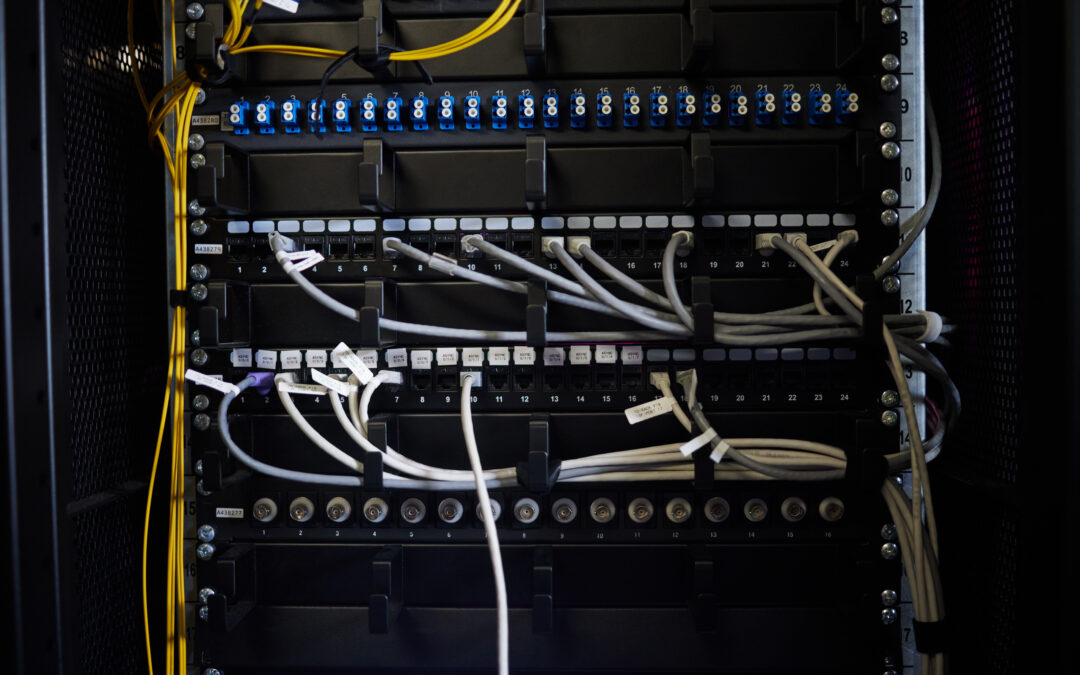
As businesses expand into larger offices, warehouses, and multi-floor facilities, network demands increase significantly. High device counts, cloud applications, security systems, and wireless connectivity all require fast, reliable data transfer across the entire building. That’s where a fiber optic backbone becomes essential.
For commercial buildings nationwide, fiber backbone installation is one of the most important upgrades for improving performance, scalability, and long-term network reliability. At Progressive Cabling, we design and install fiber backbone systems that support high-demand environments and future growth.
What Is a Fiber Backbone?
A fiber backbone is the core network connection that links main network rooms (MDFs) to intermediate distribution frames (IDFs), floors, or separate buildings. It acts as the “highway” for data, carrying large amounts of information quickly across long distances.
Unlike standard copper cabling, fiber uses light to transmit data, allowing for:
- Much higher speeds
- Greater bandwidth capacity
- Longer transmission distances
- Minimal signal loss
This makes fiber ideal for large commercial environments.
Why Large Buildings Need Fiber Backbones
In smaller spaces, copper cabling may be enough. But in large facilities, relying only on copper can create bottlenecks and performance issues.
Fiber backbones solve this by:
- Connecting multiple floors efficiently
- Supporting large numbers of devices
- Handling high data traffic without congestion
- Maintaining performance across long distances
For buildings with multiple network closets, fiber is essential for consistent connectivity.
Supporting High-Demand Applications
Modern businesses rely on applications that generate significant network traffic, including:
- Cloud-based platforms
- Video conferencing systems
- Security cameras (HD and 4K)
- Access control systems
- Wireless access points
- Data analytics and automation tools
A fiber backbone ensures these systems operate smoothly without slowing down the network.
Improving Network Speed and Performance
Fiber optic cabling offers significantly higher bandwidth than copper. This allows data to move faster between network closets and devices.
Benefits include:
- Faster file transfers
- Improved application performance
- Reduced latency
- Better support for real-time systems
For businesses that rely on speed, fiber provides a noticeable improvement.
Long-Distance Connectivity Without Signal Loss
Copper cabling typically has distance limitations of around 300 feet before performance begins to degrade. Fiber, on the other hand, can run much longer distances without losing signal quality.
This makes fiber ideal for:
- Warehouses and distribution centers
- Multi-floor office buildings
- Campus-style environments
- Industrial facilities
No matter the size of the building, fiber maintains consistent performance.
Supporting Wireless and PoE Networks
Wireless networks and PoE devices rely on strong backbone connectivity. Access points, cameras, and access control systems all send data back through the network.
A fiber backbone ensures:
- Wireless access points perform at full capacity
- Security cameras transmit high-quality video
- PoE systems remain stable and reliable
- Network congestion is minimized
This keeps all connected systems operating efficiently.
Future-Proofing Your Network Infrastructure
Technology continues to evolve, and network demands will only increase. Installing a fiber backbone now helps future-proof your infrastructure.
Fiber supports:
- Higher data speeds as technology advances
- Increased device counts
- New applications and systems
- Long-term scalability without rewiring
This reduces the need for major upgrades in the future.
Reducing Network Bottlenecks
Without a fiber backbone, data traffic can become congested as it moves through the network. This leads to slow performance and inconsistent connectivity.
Fiber eliminates these bottlenecks by providing:
- High-capacity data pathways
- Faster communication between network points
- Balanced network load distribution
This results in a smoother, more reliable network experience.
Industries That Benefit Most from Fiber Backbones
Fiber backbone installation is especially important for:
- Corporate office buildings
- Warehouses and logistics facilities
- Healthcare and medical centers
- Educational campuses
- Manufacturing plants
- Multi-tenant commercial properties
In these environments, performance and scalability are critical.
Why Businesses Choose Progressive Cabling
Progressive Cabling provides professional fiber optic installation services nationwide. Businesses choose us because we deliver:
- Certified fiber backbone installation
- Clean, organized, and code-compliant work
- Integration with structured cabling systems
- Support for PoE, cameras, and access control
- Scalable designs built for long-term performance
We build network infrastructure that supports growth and reliability.
Strengthen Your Network with a Fiber Backbone
If your business operates in a large facility or plans to expand, a fiber backbone is one of the most important upgrades you can make. It improves speed, reliability, and scalability—ensuring your network can handle today’s demands and tomorrow’s growth.
Contact Progressive Cabling today to learn how fiber backbone installation can transform your network infrastructure and support your business operations.